
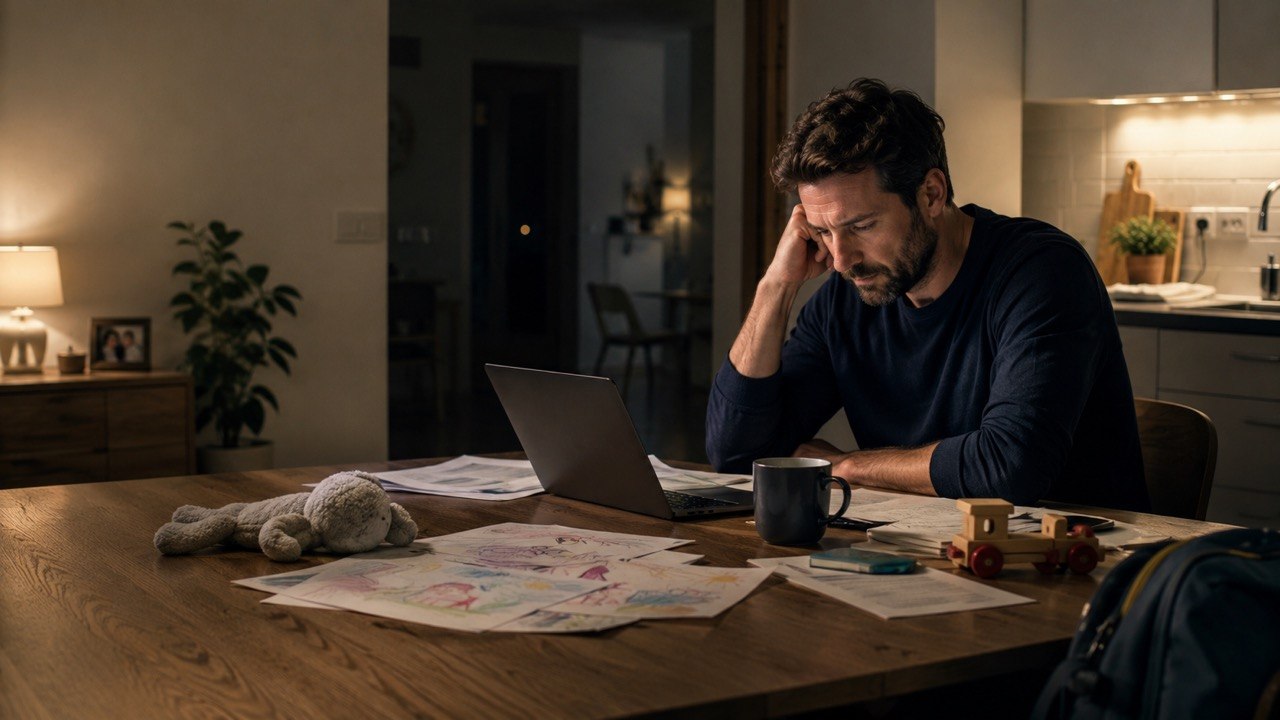
The modern father is expected to be a provider, an emotionally available partner and an actively involved caregiver at the same time. Yet while his performance is constantly scrutinised, we rarely ask him the simplest question: how is he?
Author: Olga Nádra
Doing Nothing as a Lost Luxury
Modern social discourse devotes increasing and entirely justified attention to the structural challenges faced by women, the burden of invisible labour, and the physical, emotional and economic pressures associated with motherhood. This visibility is essential for social progress. At the same time, however, we tend to overlook the fact that the erosion of patriarchal structures and the transformation of family models are also placing new, often invisible burdens on men.
Men are now rightly expected to be emotionally present fathers, caring partners and active participants in the everyday life of the family. At the same time, however, they continue to carry a substantial share of the traditional responsibility of providing for the household. The new expectations have therefore not replaced the old ones. They have simply been added to them.
Yet we rarely speak about this suffocating system of expectations. Fathers are regularly evaluated according to their performance, but their emotional state is seldom considered. This issue has both a profoundly human and a serious social-policy dimension. It is not about placing the problems of men and women in competition with each other. It is about recognising that the mental and role-related crisis affecting men has become an acute social problem that threatens the stability of relationships, families and, ultimately, communities.
The Double Trap of Traditional Burdens and Modern Expectations
The institution of fatherhood has undergone a radical transformation over recent decades. This transformation, however, has not simply replaced the traditional male role with a new model. Many of the old expectations have remained, while new ones have been placed on top of them. This collision of roles lies at the heart of one of the most profound internal conflicts experienced by modern fathers.
According to traditional social codes, a man’s primary responsibility is to provide for his family by ensuring material security, stability and physical protection. This expectation has by no means disappeared. According to Eurostat data, in 2021, 90 per cent of men aged between 25 and 54 with children were employed in the European Union, compared with 81 per cent of men without children. The presence of children therefore remains closely connected to men’s increased labour-market participation and their role as family providers.
At the same time, modern expectations rightly demand that fathers should also be emotionally present. They should participate in the everyday details of raising their children, know their children’s friends, teachers, fears and joys, contribute to domestic work, act as empathetic partners and be capable of emotional intimacy.
The problem is not that these new expectations have emerged. The problem is that society has placed them on men’s shoulders without removing the traditional burdens they already carry. Fathers are still expected to preserve the family’s financial stability during periods of economic uncertainty, while remaining consistently patient, attentive and emotionally accessible. They must work enough to create security, but not so much that they miss their children’s lives. They must be strong but sensitive, decisive but never rigid, responsible but never controlling.
Data published by the OECD in 2025 illustrate this transitional state. By 2024, 35 of the OECD’s 38 member countries provided some form of paid leave for fathers. Nevertheless, the average duration of leave reserved for fathers remained only half as long as that allocated to mothers. In the 22 countries for which comparable data were available, men’s share among recipients of parental-leave benefits increased from 19.1 per cent in 2013 to 26.1 per cent in 2023. This is undoubtedly progress, but it remains far from an equal division of care.
The struggle to balance work and family life therefore places fathers under considerable pressure as well. Yet while a recognised social vocabulary has emerged around the exhaustion associated with motherhood, many men still lack legitimate concepts through which they can describe their own burnout. A father may be tired, but he must not collapse. He may be uncertain, but he cannot lose control. He may be sad, but he is still expected to reassure everyone else.
The Culture of Silence and the Prohibition of Vulnerability
One of the greatest obstacles facing modern fathers is the social prohibition of vulnerability. Male socialisation continues to communicate that a man must be strong, unshakable and self-sufficient. He must not complain, must not ask for help and, ideally, must not reveal when he is afraid. Within the classical conception of masculinity, discussing problems, admitting uncertainty or seeking psychological support can easily become synonymous with failure.
According to a European review by the World Health Organization, the principal cultural barriers preventing men from seeking mental-health support include the expectation of self-reliance, difficulties expressing emotions and the perceived need to maintain self-control. Economic insecurity, inequality, social isolation and limited access to healthcare and social services further intensify the problem.
This culture of silence directly produces the stigmatisation of mental health, delays requests for support and allows problems to deepen. Many men reach a psychologist or another professional only when they are no longer merely overwhelmed, but when their ability to function in everyday life is already beginning to collapse.
Emotional distress does not always appear in its most widely recognised form. Sadness may manifest as irritability, anxiety as constant work, helplessness as anger, and depression as emotional withdrawal or problematic alcohol consumption. In such cases, those around the man often see only the behaviour, not the internal forces driving it.
Untreated stress, unresolved anxiety and depression do not remain a man’s private problem. They directly damage communication within the relationship, increase the risk of conflict within the family and may emotionally distance a father from the very people for whom he is struggling with all his strength.
Allies in Crisis: The Responsibility of Wives
It is impossible to speak honestly about men’s emotional isolation without addressing the role of the spouse and, more specifically, the responsibility of wives.
This does not mean that women must save men, take over their problems or become therapists within the relationship. It does mean, however, that marriage is not merely a legal and economic arrangement. It is also an emotional alliance. A partner cannot remain an indifferent observer while the other person gradually collapses over a period of months or years.
Because many men lack an extensive and emotionally profound support network in which they can regularly discuss their fears without judgement, the role of the wife often becomes critically important. A partner may be the first person to recognise that a man is no longer simply tired, but hopeless; no longer merely quiet, but isolated; no longer simply working hard, but escaping into work.
One recurring problem within family dynamics is the incompetence trap. Many fathers withdraw from the everyday responsibilities of raising children because they feel that whatever they do is not good enough. They may not dress the child in exactly the same way, follow the evening routine in the same order, pack the schoolbag according to the same logic or resolve conflicts using the same methods.
When a wife interprets every difference as a mistake, continually overrules the father and then accuses him of failing to participate sufficiently in childcare, she contributes to the very dynamic from which he eventually withdraws. There is not only one legitimate form of care. When a wife allows the father to care for the children according to his own pace, logic and relationship with them, she is not doing him a favour. She is recognising his competence as a full and equal parent.
Trust is not the absence of control. Trust is the acceptance that the father is not a substitute for the mother or a less capable assistant, but an autonomous and equal parent.
The space for communication without masks is equally important. Men often do not communicate distress in the way those around them expect. They may not explicitly say that they are anxious, afraid or losing hope. An emotional crisis may instead appear as irritability, silence, insomnia, excessive work or emotional detachment.
A wife’s responsibility in such circumstances is not to tolerate everything. A mental-health crisis does not excuse abusive or humiliating behaviour. However, it is necessary to distinguish between someone who is attacking and someone who is clumsily attempting to defend himself against his own collapse.
A non-judgemental question can often achieve more than an accusation. What is happening to you? How long have you felt this way? What are you afraid of? How can I stand beside you? A man needs a space in which he can say that he is exhausted, that he is afraid he will not be able to provide for his family, or that he does not know how to resolve a situation. When every vulnerable admission is later used against him as a weapon during an argument, he learns that silence is safer than honesty.
Family members and close relatives can also play a decisive role in whether a man eventually seeks professional support. According to the WHO review, men are more likely to show vulnerability and ask for help from people they regard as trustworthy, including family members, friends, peers and professionals.
As a rational and emotional ally, a wife can normalise the act of seeking help. She can make it clear that visiting a psychologist is not the loss of masculinity, but an act of responsibility. She may help find a suitable professional or appointment, accompany her husband to the first meeting, or simply reassure him that she will not respect him less because he needs support.
A wife is not a therapist, but neither is she a neutral external observer. Marriage is an alliance, and an alliance carries responsibility.
When the System Punishes: Fathers’ Struggle After Divorce
Periods of crisis reveal even more sharply the rigid assumptions through which society and its institutions continue to view fathers. Following divorce or separation, maintaining a close, everyday relationship with their children becomes a traumatic struggle for many men. Almost overnight, a father may lose the bedtime stories, the morning preparations, the journey to school, and the small conflicts and joys of ordinary family life. He does not necessarily lose his child completely. He loses the everyday practice of fatherhood that had previously formed a central part of his identity.
A study examining 2021 data from 17 European countries found that 12.5 per cent of children with separated parents divided their time equally between the two households. A further 8.2 per cent spent at least one-third of their time with each parent. By contrast, 79.3 per cent continued to live primarily in the household of only one parent. The proportions varied considerably between countries, and sole or primary residence remained the dominant arrangement in every country examined except Sweden.
This does not in itself prove that every judicial or family decision is unjust. It does, however, demonstrate clearly that genuinely shared parental presence after divorce remains far from becoming the general European model.
Every family situation is unique, and the best interests of the child must remain the primary consideration. Nevertheless, legal and social practice still often treats the mother almost instinctively as the principal caregiver. The father can consequently be reduced to the role of a weekend visitor and maintenance payer.
This does not punish only the father. It may also deprive the child of the opportunity to maintain a deep and continuous everyday relationship with both parents.
The responsibility of wives and former wives cannot be avoided in this area either. The end of a relationship must not automatically lead to the devaluation of fatherhood. A child cannot be used as an instrument to punish a former partner, contact cannot be made dependent on emotional bargaining, and a father’s parental competence cannot be questioned simply because the marriage has failed.
A mother who unjustifiably restricts the relationship between a child and the father is not merely continuing a conflict with her former husband. She is also damaging one of the child’s fundamental emotional relationships.
The same naturally applies in the opposite direction. A father must not use the child to control or intimidate the mother, or to continue the divorce through other means. Parental responsibility does not disappear when the marital relationship ends.
Recognition that a father continues to possess both a legitimate parental claim and a profound emotional need to experience everyday fatherhood after divorce often encounters institutional and social resistance. This exclusion can produce a severe identity crisis, particularly when a man was previously actively involved in his children’s lives and is suddenly transformed into a secondary figure.
The Most Severe Symptom: The Statistics We Cannot Sweep Aside
Behind unspoken problems, emotional isolation and the failure to seek help lies a grave social reality.
The latest complete and comparable European Union data currently available relate to 2022. In that year, the standardised death rate associated with intentional self-harm in the EU was 10.6 deaths per 100,000 inhabitants. The male mortality rate was 3.6 times higher than the female rate. Among those under the age of 65, the difference was 3.3-fold, while among those aged 65 and over it reached 4.1-fold. In every EU Member State, the suicide mortality rate was higher among men than among women. Hungary recorded a standardised rate of 16.7, the third-highest figure in the European Union after Slovenia and Lithuania.
This is not merely a public-health statistic. It is the most severe social symptom of the culture of silence.
Men do not die by suicide more frequently because they necessarily face more problems than women. They also die because they have been socialised within a culture that equates independence with the rejection of help, strength with the suppression of emotion, and masculinity with maintaining the appearance of control.
The culture of silence directly increases the risk that a man will seek help too late. Suppressed fear does not disappear; it becomes isolation. Unspoken anxiety is not resolved; it gradually closes the world around the individual. The constant pressure to perform can erode self-worth until a person can no longer see another way out.
The male suicide rate therefore cannot be discussed exclusively as a clinical or individual problem. It is also a social, cultural, economic and family-policy issue. Behind the statistics are fathers, husbands, sons and brothers, a significant number of whom reach the point of final collapse without those around them recognising the depth of the crisis in time.
Partnership Through Vulnerability
In a healthy and sustainable society, the challenges and specific vulnerabilities of both sexes matter. Supporting fathers does not mean relativising or diminishing the difficulties faced by mothers. On the contrary, the two can function only together. A mentally stable, emotionally available and supported father represents a genuine partner to his wife and a secure, predictable presence for his children.
Social institutions must also adapt to the transformation of fatherhood. It is not enough to demand active caregiving from men if workplace culture continues to treat the use of paternity or parental leave as a sign of weakness. It is not enough to demand emotional presence if there are scarcely any targeted and easily accessible mental-health services available to men. Nor can we speak meaningfully about equal parenthood if the father’s actual presence automatically becomes secondary after divorce.
Change must also take place within families. Wives must recognise that their husbands’ vulnerability is not the absence of masculinity, but part of the human condition. Men, in turn, must learn that honesty is not a loss of power and that asking for help is not failure.
Fathers do not carry only responsibilities and financial burdens. They also deserve empathy, trust and structural support. They need more than occasional expressions of gratitude for everything they do. They need those around them to notice when the weight of their role has left them barely able to continue.
We must collectively redefine the meaning of masculinity. Strength does not mean carrying every burden in silence until the point of total exhaustion. Strength also means possessing the self-awareness and courage to say:
I am not well. I cannot solve this alone. I need help.
Cover photo credit: CEA Magazine. Edited with AI assistance using ChatGPT

Olga Nádra is a social worker and a specialist in gerontology and mental health. She completed her studies at Kodolányi János University. She has more than fifteen years of practical experience in elderly care as well as in supporting people with psychiatric conditions. Her work is grounded in empirical insights gained in the field, through which she engages with questions related to mental health, care systems and the social welfare system. She believes strongly in lifelong learning and therefore continues to deepen her professional knowledge through ongoing training and research.
Support independent analysis and journalism at CEA Magazine: https://centraleuropeanaffairs.com/donation
For more insights on Central European political risk, EU institutional developments, and transatlantic relations, follow CEA Magazine and the CEA Talk podcast.
